

As a supplier of multistage centrifugal pumps, I've witnessed firsthand the critical role that diffusers play in these remarkable machines. Multistage centrifugal pumps are widely used in various industries, including water supply, oil and gas, and chemical processing, due to their ability to generate high pressures and handle large volumes of fluid. In this blog post, I'll delve into the functions and significance of diffusers in multistage centrifugal pumps, shedding light on why they are essential components for optimal pump performance.
Understanding the Basics of Multistage Centrifugal Pumps
Before we explore the role of diffusers, let's briefly review how multistage centrifugal pumps work. These pumps consist of multiple impellers arranged in series on a common shaft, each housed within a separate stage. As the fluid enters the pump, it is first accelerated by the impeller in the first stage, which imparts kinetic energy to the fluid. The fluid then flows into the next stage, where the process is repeated, with each subsequent impeller adding more energy to the fluid. This sequential arrangement of impellers allows multistage centrifugal pumps to achieve high discharge pressures.
The Function of Diffusers in Multistage Centrifugal Pumps
Diffusers are stationary components located between the impellers in a multistage centrifugal pump. Their primary function is to convert the kinetic energy of the fluid leaving the impeller into pressure energy. As the fluid exits the impeller at high velocity, it enters the diffuser, which has a gradually expanding passageway. This expansion causes the fluid velocity to decrease, while simultaneously increasing the pressure. In essence, the diffuser acts as an energy converter, transforming the high - velocity, low - pressure fluid from the impeller into a low - velocity, high - pressure fluid.
One of the key benefits of using diffusers is that they help to improve the overall efficiency of the pump. By converting kinetic energy into pressure energy, diffusers reduce the amount of energy that is wasted as fluid turbulence. This results in a more efficient transfer of energy from the impeller to the fluid, which in turn reduces the power consumption of the pump. A more efficient pump not only saves energy but also reduces operating costs over the long term.
Another important function of diffusers is to guide the fluid smoothly from one impeller to the next. The carefully designed passageways in the diffuser ensure that the fluid flow is evenly distributed and that there are no sudden changes in direction or velocity. This smooth flow helps to minimize hydraulic losses and prevent cavitation, a phenomenon that can cause damage to the pump components and reduce its performance.
Types of Diffusers
There are several types of diffusers used in multistage centrifugal pumps, each with its own unique design and characteristics.
Vaned Diffusers
Vaned diffusers are the most common type of diffuser used in multistage centrifugal pumps. They consist of a series of fixed vanes arranged in a circular pattern around the impeller outlet. The vanes help to guide the fluid flow and control the expansion process. Vaned diffusers are known for their high efficiency and ability to handle high - flow rates. They are suitable for a wide range of applications, including water supply, irrigation, and industrial processes.
Volute Diffusers
Volute diffusers, also known as scroll diffusers, have a spiral - shaped passageway that surrounds the impeller. As the fluid exits the impeller, it enters the volute, which gradually expands, causing the velocity to decrease and the pressure to increase. Volute diffusers are often used in smaller pumps or applications where simplicity and compactness are important. They are less efficient than vaned diffusers but are easier to manufacture and maintain.
Impact on Pump Performance
The design and performance of the diffuser have a significant impact on the overall performance of the multistage centrifugal pump. A well - designed diffuser can improve the pump's head - capacity curve, which shows the relationship between the pump's discharge pressure (head) and the flow rate. A steeper head - capacity curve indicates that the pump can maintain a higher pressure at a given flow rate, which is desirable in many applications.
Diffusers also affect the pump's efficiency curve. By optimizing the diffuser design, it is possible to achieve a higher peak efficiency, which means that the pump can operate more efficiently over a wider range of flow rates. This is particularly important in applications where the flow rate may vary, such as in water distribution systems.

Applications and Considerations
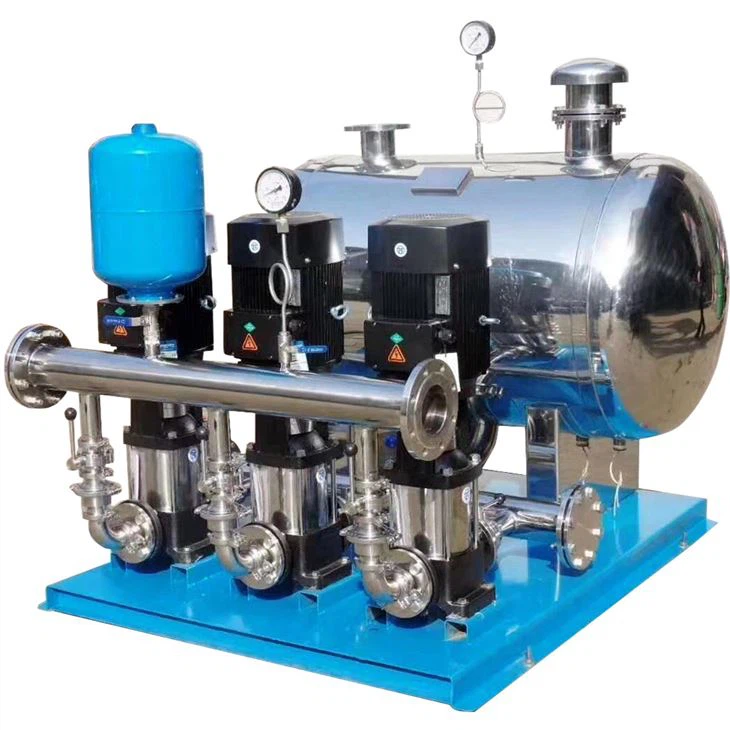
Multistage centrifugal pumps with well - designed diffusers are used in a wide variety of applications. For example, in water supply systems, these pumps are used to boost the pressure of water to ensure that it can reach high - rise buildings or remote areas. Our Booster Pump Set is specifically designed for such applications, with diffusers that are optimized for high - pressure performance.
In the oil and gas industry, multistage centrifugal pumps are used for pipeline transportation, where high pressures are required to move the fluid over long distances. Our Horizontal Centrifugal Multistage Pump is a popular choice for these applications, thanks to its robust design and efficient diffuser system.
For applications where space is limited, such as in small industrial plants or residential buildings, our Vertical Multistage Centrifugal Pump offers a compact solution. The diffusers in these pumps are designed to work effectively in a vertical configuration, ensuring high performance even in confined spaces.
When selecting a multistage centrifugal pump, it is important to consider the design and performance of the diffusers. Factors such as the type of diffuser, its size, and the material of construction can all affect the pump's performance and reliability. It is also important to ensure that the diffuser is properly matched to the impeller design to achieve optimal efficiency.
Conclusion
In conclusion, diffusers play a crucial role in the operation of multistage centrifugal pumps. By converting kinetic energy into pressure energy, improving efficiency, and guiding the fluid flow, diffusers help these pumps to achieve high discharge pressures while minimizing energy consumption. As a supplier of multistage centrifugal pumps, we understand the importance of diffusers in pump performance, and we are committed to providing pumps with high - quality diffusers that are optimized for various applications.
If you are in the market for a multistage centrifugal pump, we invite you to contact us to discuss your specific requirements. Our team of experts can help you select the right pump and diffuser combination to meet your needs and ensure optimal performance. Whether you need a pump for water supply, industrial processes, or any other application, we have the solutions you are looking for.
References
- Stepanoff, A. J. (1957). Centrifugal and Axial Flow Pumps: Theory, Design, and Application. John Wiley & Sons.
- Karassik, I. J., Messina, J. P., Cooper, P. T., & Heald, C. C. (2008). Pump Handbook (4th ed.). McGraw - Hill.
- Gülich, J. F. (2010). Centrifugal Pumps (2nd ed.). Springer.